
Many veterans are used to carrying everything alone. You trained your mind and body to stay alert, push through, and keep moving. That survival wiring does not turn off just because you are home. Trauma and PTSD therapy helps you process what you have lived through and build a healthier life on the other side of it.

Many veterans avoid therapy because it feels like explaining everything from the beginning only to be met with blank stares or generic advice. That misses the point. You should not have to prove your pain for it to matter.
I have worked with veterans and military families for years and have lived close to military life through family and marriage. I understand survival mode and the patterns it creates. I do not use a scripted, cookie cutter approach. I meet you with respect, clarity, and direct work that helps you move forward.

You are not too much. You are not broken. You survived. And we can work with that.
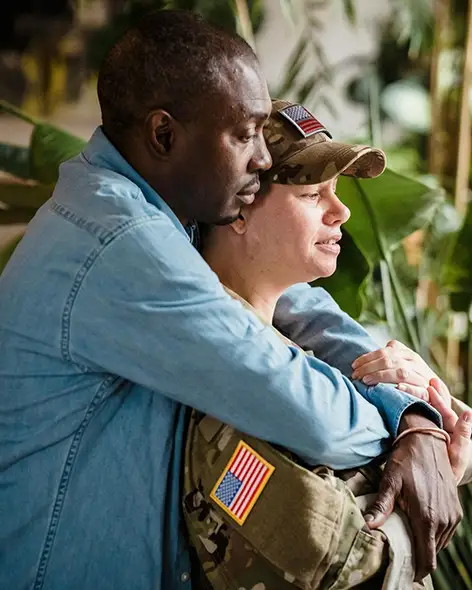
Trauma and PTSD therapy for veterans is structured, evidence based treatment designed to address how military experiences affect the brain and nervous system. PTSD can develop after combat exposure, military sexual trauma, moral injury, or prolonged high threat environments. It can show up as hypervigilance, anger, emotional shutdown, sleep disruption, avoidance, intrusive memories, or difficulty reconnecting at home.
Trauma focused psychotherapy is widely recommended in national PTSD treatment guidelines because it works directly with traumatic memory rather than only managing surface symptoms. That means we are not just coping. We are processing.
In my work, I use trauma focused approaches such as EMDR therapy for reprocessing traumatic memories, Cognitive Behavioral Therapy to shift patterns that reinforce stress responses, DBT skills for emotional regulation, and nervous system regulation work to help your body come out of constant survival mode. These approaches are used because they help reduce PTSD symptoms at the root.
My goal is not just symptom reduction. It is helping you understand why your reactions make sense, process what needs to be processed, and move forward with clarity and stability. You do not have to stay wired for threat.
PTSD often keeps your nervous system scanning for danger even in safe environments. Trauma therapy helps recalibrate that response so your body is not braced all the time.
Many veterans carry moral injury or unresolved guilt. Therapy creates space to process those experiences in a structured way so they stop replaying internally.
When survival mode has been active for years, reactions can come fast. We work on strengthening emotional regulation so your responses feel proportional and intentional.
PTSD can impact connection, intimacy, and communication. Trauma therapy helps repair relationship patterns shaped by survival wiring.
Trauma focused approaches such as EMDR can reduce the intensity of intrusive memories and support more restorative sleep.
Many veterans struggle with identity after transition. Therapy supports integrating your service into your story without letting it define your entire future.

Trauma therapy with veterans requires more than supportive conversation. I use trauma focused, evidence based approaches designed specifically for PTSD and military related trauma.
Trauma Focused Cognitive Behavioral Therapy (TF CBT) helps you process trauma in a way that feels structured, steady, and supportive.
Instead of just looking at thoughts and emotions in general, TF CBT focuses on how trauma can shape your nervous system, beliefs, and sense of safety. After something overwhelming, your mind and body can get stuck in survival mode. You might feel on edge, shut down, easily triggered, or constantly bracing for something bad to happen.
In TF CBT, we gently identify the trauma related thought patterns and reactions that keep showing up in your daily life, then build practical tools to help you feel more grounded, regulated, and in control. You’ll learn skills you can use outside of session to manage triggers, reduce anxiety, and reconnect with a sense of safety. As your brain and body begin to feel safer, your emotions and relationships often start to shift too.
EMDR therapy helps your brain reprocess traumatic memories so they no longer carry the same emotional charge. Trauma can get “stuck” in the nervous system, which is why you may react strongly to things that logically shouldn’t feel that intense. EMDR allows the brain to complete processing that didn’t happen at the time of the trauma. I often use EMDR when someone feels stuck, especially with military trauma, childhood trauma, or repeated relational wounds. It can create powerful movement when talk therapy alone only goes so far.
Dialectical Behavior Therapy focuses on changing behaviors to influence emotions. Sometimes we shift the behavior first and the feelings follow. DBT skills help with emotional regulation, distress tolerance, and learning how to pause before reacting. If anger, impulsivity, shutdown, or relationship conflict are patterns for you, DBT gives you real-world strategies to respond differently. It’s about learning how to stay grounded when your emotions want to take over.
Trauma focused therapy means we understand that your reactions make sense in the context of what you’ve lived through. Whether your trauma was one major event or years of walking on eggshells, your nervous system adapted to survive. Instead of labeling you as “too sensitive” or “overreactive,” we look at how your history shaped your patterns. From there, we work at the root so those survival responses don’t keep running your life.
Trauma lives in the body, not just in memory. Mindfulness and nervous system regulation help bring your body out of fight, flight, or freeze. We use grounding exercises like the five senses, present-moment awareness, and guided practices to help you feel more stable and less reactive. When your nervous system learns it is safe, your mind can finally rest. This work is foundational in trauma therapy.
A big part of my approach is helping you understand why you do what you do. When you realize your reactions are trauma responses and not character flaws, shame starts to loosen its grip. I explain how the brain and nervous system work so your story makes sense. Realization is the first step. Then we ask, “Now what are we going to do with that?”
Many trauma survivors struggle with boundaries. You may have learned to prioritize everyone else’s needs or to keep the peace at all costs. Boundary work is about learning where you end and someone else begins. It’s about saying no without collapsing into guilt. It’s about choosing responsibility without self-blame. This is a key part of healing dysfunctional family patterns and codependency.
Not all trauma started with you. Intergenerational trauma recognizes that patterns, coping styles, and emotional wounds are often passed down through families. If you grew up walking on eggshells, managing other people’s emotions, or feeling responsible for keeping the peace, that didn’t come from nowhere. We identify those patterns so they stop repeating in your adult relationships.
There is a strong connection between trauma, chronic stress, and physical symptoms. I often see trauma histories connected with chronic pain, autoimmune disorders, and long-term stress conditions. This does not mean symptoms are “in your head.” It means your nervous system has been under strain for a long time. Trauma therapy helps regulate that system so your body is not constantly bracing for danger.
If spirituality is important to you, we can incorporate it into your therapy. I offer faith-supportive therapy and respect your belief system, whether that is Christian, pagan, spiritual, or something uniquely personal. Some clients find meaning through prayer, meditation, or even tarot as a reflective tool. Others prefer to keep therapy grounded in psychology only. The direction is always client-led. Your belief system is respected, not pathologized.
I am not the therapist who sits back and asks how that makes you feel in circles. I am direct and grounded. I will help you understand what is happening and what needs to shift. We are not putting a Band Aid on old wounds. We are working at the root.

If you’re ready to stop circling the same problems and actually move forward, I’d be honored to walk that path with you.
I’m not the therapist who sits back and says, “And how does that make you feel?” I’m direct, grounded, and very human. I’ll sit with you in the hard things, but I’ll also tell you the truth about what needs to shift. We’re not putting a Band-Aid on old wounds. We’re healing them at the root.

If you’re ready to stop circling the same problems and actually move forward, I’d be honored to walk that path with you.

We identify the patterns you are living with and what they are protecting you from.
We process what is underneath, using trauma focused tools like EMDR when appropriate.
We build real world strategies so your daily life stops being run by trauma wiring.
Yes. I accept Aetna Medicare Advantage, Ambetter, Ascension (Smart Health), Blue Cross Blue Shield Massach, BlueCross and BlueShield, Carelon Behavioral Health, Cigna and Evernorth, ComPsych, Devoted Health Medicare Advantage and UnitedHealthcare/Optum, ESI Employee Assistance Group, Florida Blue, Horizon Blue Cross Blue Shield, New Directions | Lucet, Optum, Oscar Health, Oxford, Quest Behavioral Health, TRICARE, United Medical Resources (UMR), and UnitedHealthcare UHC | UBH.
HSA, FSA, credit card, and private pay are also accepted.
Yes. All sessions are offered virtually for adults living in Florida.
You do not have to. We focus on what is most urgent first and we go at a pace that keeps you grounded.
Yes. I work with combat related PTSD, complex trauma, moral injury, and military sexual trauma using trauma focused therapy approaches.
I respect this concern. I have worked with veterans and military families for years and have lived close to military life personally. You will not have to convince me your experience matters.
That is normal. We can start with a free consult and see if it feels like a fit.
If you’re ready to get started, you can use the button below to book an appointment or fill out the form to request a free consultation.
Log in to your account to book an appointment.